
Procrastination app
A procrastination app that shrinks the task until starting is easy
Procrastination is rarely laziness. It's usually avoidance of a feeling — the task is ambiguous, or large, or you expect to do it badly. Your brain solves that discomfort by finding something easier, and your phone is always the easiest thing in the room.
So the fix has two parts: Liftora shrinks the task until starting is easy, and makes the escape harder.
4.7★ · 500+ downloads · Free on iOS & Android
Make the first step embarrassingly small
'Write the report' triggers avoidance. 'Open the document and write the first sentence' usually doesn't. Liftora's coach breaks stalled tasks down until the first action takes two minutes, because momentum after starting is far more reliable than motivation before it. There's real psychology underneath: the brain resists ambiguous, high-stakes tasks far more than concrete, tiny ones. Lower the activation energy far enough and starting stops feeling like a decision at all. Once you're two minutes in, the avoidance usually dissolves on its own — the task stops being a threat and becomes a thing you're already doing.
- Two-minute entry points for tasks you keep deferring
- A single visible next action instead of a long list
- Focus sessions short enough to agree to (start at 15 minutes)
- Immediate feedback — XP and a completed block — for starting
Close the escape routes
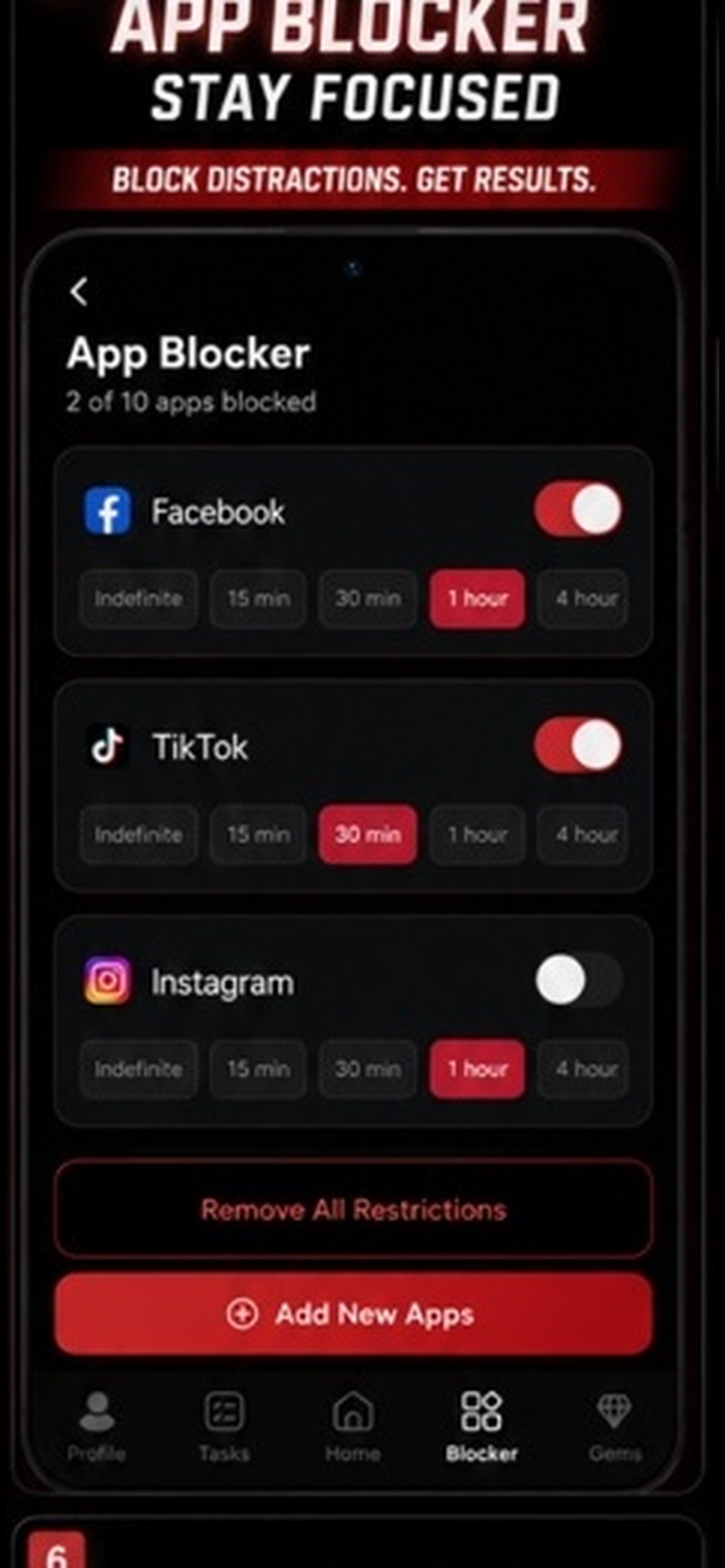
You will lose a willpower contest against an infinite feed. Schedule blocking during your focus windows means the contest doesn't happen, and strict mode stops the 'just quickly check' bypass that undoes an otherwise good afternoon. The timing matters as much as the blocking itself. Protection has to be armed before the difficult moment arrives — scheduled the night before — because willpower at 3pm was never going to win that fight unaided. Most people are surprised by how little willpower is left to exercise once the escape routes are closed — starting becomes the path of least resistance. Combined with the tiny first step, the effect compounds: starting is easy and stopping is hard, which is exactly the reverse of the usual setup.
Notice the pattern, not just the day
Everyone procrastinates predictably. Liftora's stats show which tasks get postponed repeatedly and when — and a task that's been rescheduled five times is usually badly defined rather than genuinely hard. The coach will prompt you to redefine it, break it up, or drop it honestly. That shift — from judging single days to reading the pattern — is what makes the fix stick. A bad day is weather; the same task slipping every week is climate, and climate is what you redesign. Over a month the pattern map becomes the most honest mirror you have: it shows exactly which commitments you keep and which ones keep slipping, with dates attached.
Deadlines you set before you need them
Self-imposed deadlines only work when something follows them. Tying the task to a scheduled block, a streak and a weekly check-in gives it the same pull an external deadline has — which is why the review matters more than the reminder. It works because the stakes become visible. A skipped session costs a streak, shows up in the weekly review, and gets asked about — enough social-proof-of-self to compete with the comfort of putting it off again. The effect is strongest for the vague, important tasks — the ones with no external deadline at all, which are precisely the ones that get deferred forever.
Frequently asked questions
- How do I stop procrastinating?
- Shrink the first step to something that takes two minutes, schedule a specific time for it, and remove the easiest distraction during that window. Then track whether it happened, because the pattern tells you what to change next.
- Why do I procrastinate on things I care about?
- Usually because the stakes make failure feel more likely, which increases avoidance. Smaller first actions lower the perceived stakes enough to start.
- Does app blocking really help?
- For most people it's the highest-impact single change, because it removes the decision at the exact moment your self-control is lowest.
- Is the Pomodoro technique built in?
- There's a focus timer you can set to whatever interval works — 15, 25 or 50 minutes — paired with the blocklist for that session.
Keep reading
Try Liftora free
AI coaching, habit tracking, goals, routines and app blocking in one app. Free core features on iOS and Android.